
| The short version, as of late September 2026: – The 30-year fixed mortgage rate averaged 7.03% on September 24, 2026, up from 6.66% four weeks earlier and 6.30% a year ago (Freddie Mac). – Mortgage applications to buy a home ran 11% to 19% below the same weeks of 2025 during September (Mortgage Bankers Association). – Massachusetts had 22% more single-family homes for sale in August 2026 than a year earlier, and average sale prices fell four months in a row from their April peak (MLSPIN). – The homes still selling close to asking price are move-in ready and priced aggressively. Houses that need work, or are priced above the market, are sitting. – For a house with real condition problems, a direct sale to a cash buyer is usually the fastest option with the fewest costs and the least risk of a deal falling apart. |
In the last week alone, three Massachusetts homeowners called us about the same problem. Their house had been on the market for weeks, one had been on the market for months. There was little to no showing activity and nobody was making an offer…
None of them fit the stereotype of a house that doesn’t sell. These were nice homes. The owners had put real money into them — updates, improvements, the work you’re supposed to do before you list. They’d priced them where their agents told them the market was. And the houses were still sitting there, with the showings thinning out and the fall calendar running down.
What they all had in common was that they needed to sell. A job move, a second mortgage payment, an estate that has to be settled. And when you need to sell and the market has stopped answering, the conversation changes fast.
If that sounds like your situation, this article explains what changed this fall, which houses are still selling and why, and what your realistic options are if yours isn’t one of them.
What Changed? Mortgage Rates Crossed 7% in September
The simplest explanation for a quiet fall is the one on every lender’s rate sheet.
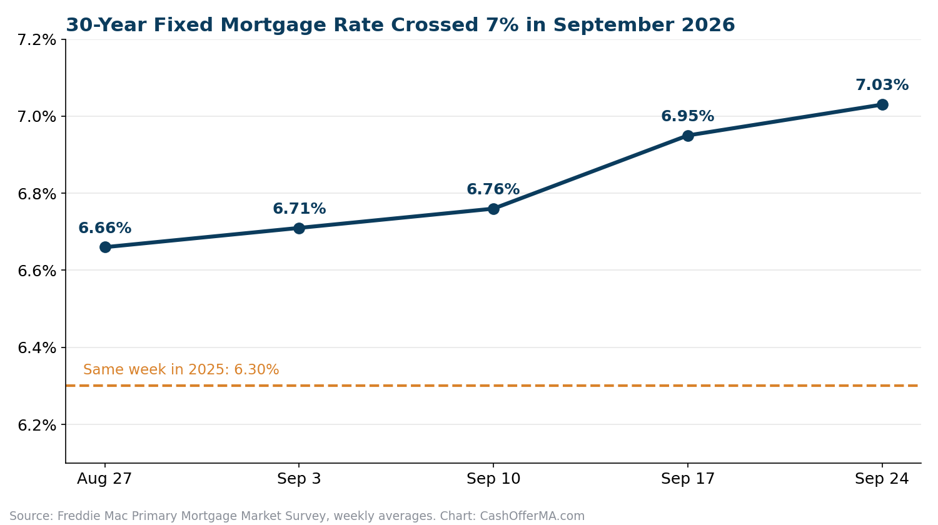
Five weeks, 37 basis points, and the first reading above 7% in at least a year.
According to Freddie Mac’s weekly mortgage survey, the average 30-year fixed rate climbed every week in September: 6.66% at the end of August, 6.71%, 6.76%, 6.95%, and then 7.03% on September 24, 2026. A year ago the same survey read 6.30%. Daily lender pricing ran even higher than that by the last week of the month, because the 10-year Treasury yield — the benchmark mortgage rates follow — pushed past 5%.
And weekly averages smooth out how jumpy this market has actually been. Sammy Illiopoulos of Guaranteed Rate says the speed of the swings is doing as much damage as the rate itself:
“The mortgage market has become increasingly difficult for buyers to navigate because of significant interest-rate volatility. When rates can move by roughly 1% within a 45-day period, it becomes extremely challenging for buyers to establish a reliable monthly-payment budget.”
— Sammy Illiopoulos, Guaranteed Rate
Think about what that means for someone shopping for a house. A buyer who gets pre-approved today can’t be sure what their payment will be by the time they close. That’s a hard moment to commit to any house, and harder still to commit to one that will need a check for repairs on top of the mortgage.
Buyers responded exactly the way you’d expect. The Mortgage Bankers Association reported that purchase applications for the week ending September 11 were 19% lower than a year earlier, and still 11% lower the following week. Its economists put it plainly: higher rates caused many buyers to pause.
Illiopoulos sees the same thing from the lending side:
“That uncertainty is also contributing to a significant slowdown in mortgage applications, as many prospective buyers hesitate to move forward when the financing environment can change so quickly.”
— Sammy Illiopoulos, Guaranteed Rate
That hesitation is what sellers are feeling. Fewer buyers are pre-approved, the ones who are have smaller budgets, and a lot of the people walking through open houses are now browsing rather than buying.
What a 7% Rate Does to a Buyer’s Budget
Rate headlines are abstract. Here is what they mean for the person who is supposed to buy your house.
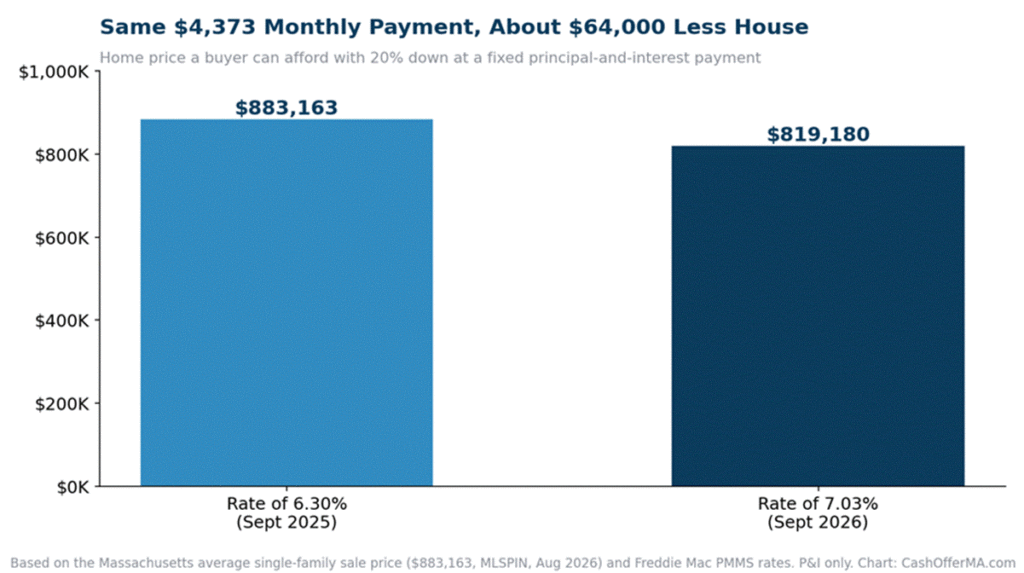
Same payment, same buyer, roughly $64,000 less house.
Take the average Massachusetts single-family sale price in August 2026, which was $883,163. A buyer putting 20% down at last September’s 6.30% rate would pay about $4,373 a month in principal and interest. At 7.03%, the same house costs about $4,715 a month — roughly $342 more every month, or about $4,100 a year.
Flip it around and it gets worse for sellers. If that buyer’s budget is fixed at $4,373 a month, the most house they can now afford is about $819,000. Nothing about your home changed. The buyer’s purchasing power dropped by about $64,000 in twelve months.
And that math assumes a buyer with 20% down. Plenty of Massachusetts buyers are stretching to get 5% or 10% together for a down payment. For them, the down payment and closing costs took every dollar they had. There is nothing left over for a new roof, a kitchen, or a septic system.
Now hold onto that point. It’s the whole reason the market has split in two.
Is the Massachusetts Housing Market Slowing Down?
Yes, and the slowdown started before rates made the headlines. Our monthly Massachusetts market reports have been tracking it since spring using MLSPIN single-family data.
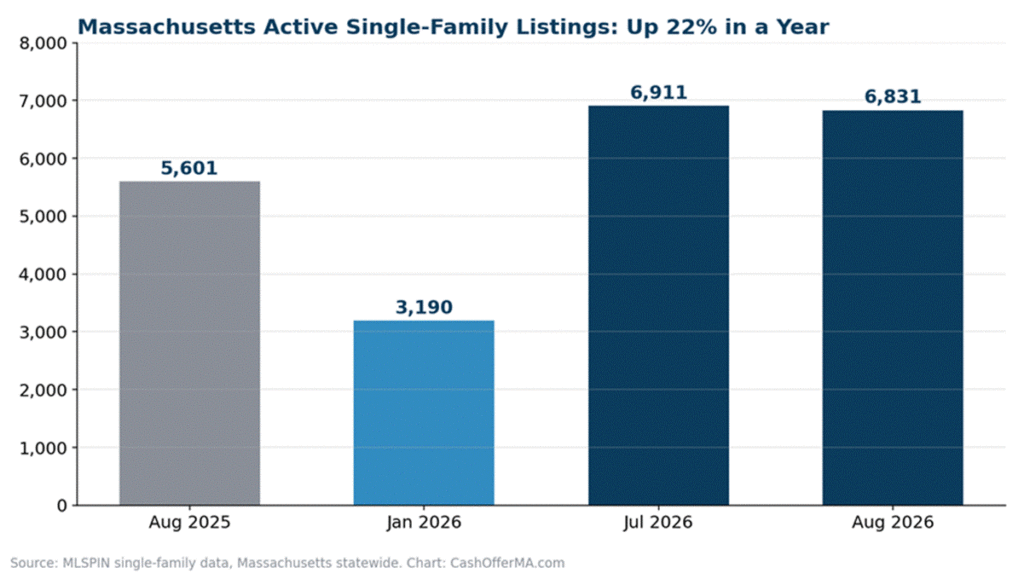
More than twice as many homes for sale as in January, and 22% more than last August.
Through August 2026, the statewide numbers looked like this:
- Inventory is up sharply. 6,831 single-family homes were actively listed in August, against 5,601 a year earlier — a 22% increase. In January there were just 3,190.
- Prices peaked in spring. The average sale price hit $910,859 in April and fell in each of the next four months, to $883,163 in August.
- Homes take longer to sell. Houses that closed in August averaged 39 days on market, up from 35 a year earlier.
- The bidding-war premium is gone. The average home sold for 100.17% of its asking price in August. The spring peak was 101.42%.
All of that was before September’s rate spike. Buyers were already gaining leverage over the summer. Rates crossing 7% just handed them more of it.
Which Houses Are Still Selling in Massachusetts Right Now?
Here’s the part the averages hide. When you hear that Massachusetts homes are still selling at about 100% of asking price in 39 days, that doesn’t describe every house. It describes the houses that sold.
And that percentage is also based off of the current asking price. Quick example, say 123 Main Street was originally listed for $650,000. It had two price reductions going from $625,000 then to $575,000 as the seller was becoming a desperate. A bidding war ensues and the house sells for $580,000. Statistically speaking that house sold for 100.87%. Not the 11.5% discount from its original price.
These sale price percentages also don’t take into account seller credits that may have been used to close the deal. Credits like closing cost credits or inspection issue credits.
From what we see every week, the homes going under agreement this fall without a big discount share two traits:
- They are in move-in condition. Updated kitchen and baths, a newer roof and mechanicals, nothing an inspector will flag as a big-ticket repair. The buyer with a stretched budget can move in and spend nothing.
- They are priced aggressively. Not at last spring’s number, and not with room left to “see what happens.” Priced at or just under what the market will bear today, so they draw the few active buyers in that price range right away.
A home that checks both boxes still sells. A home that checks only one is struggling. And a home that checks neither is the house that sits — sometimes all season.
Why Houses That Need Work Are Sitting the Longest
Go back to that buyer with the smaller budget and no money left over after closing. Now show them a house with a 1970s kitchen, an original heating system, or water stains on the basement walls.
They can’t take it on. Not because they don’t like the house, but because a 7% mortgage and a renovation budget don’t fit into the same household. A few things happen next, and none of them are good for the seller:
- The house gets skipped. Buyers scrolling listings filter it out, or tour it and move on to the updated place down the street that costs a little more.
- The offers that do come in are low. A buyer who can do the work prices in the repairs, a cushion for surprises, and the extra time the house has been sitting.
- Deals fall apart after the inspection. The buyer’s inspector writes up the roof, the electrical, or the moisture, and the buyer comes back asking for a large credit or walks away.
- The lender says no. Some conditions — active leaks, a failed septic, missing heat — can make a house ineligible for standard financing until they’re fixed, which removes most buyers from the pool entirely.
Meanwhile, inventory keeps building around the listing, and every week it sits the listing gets staler in buyers’ eyes.
The Double Hit: Price Cuts Plus Commission
Sellers of houses that need work are taking two losses at once this fall, and the second one surprises people.
The first is the one everyone expects: price reductions. The second is that the listing commission — commonly several percent of the sale price — still comes off the top of whatever number you finally accept. So does every month of mortgage, taxes, insurance and utilities while you wait.
Here’s a simplified, hypothetical example to show how quickly it adds up:
| Hypothetical house that needs work | Amount |
| Original list price | $650,000 |
| Two price reductions over the fall | –$40,000 |
| Repair credit negotiated after inspection | –$15,000 |
| Commission at 5% of the $595,000 final price | –$29,750 |
| Four extra months of carrying costs at $4,000/month | –$16,000 |
| Roughly what’s left before other closing costs and the mortgage payoff | $549,250 |
Illustrative only. Your commission rate, carrying costs and price reductions will differ, and some houses sell with no cuts at all.
The listing price said $650,000. The seller is walking away with about $100,000 less than that before the mortgage is even paid off — and that’s the version where the house eventually sells. If it expires and comes back in the spring, the carrying costs keep running.
Even Updated Houses Are Sitting Right Now
It would be easy to read all of this as a problem only for tired houses. The three calls we got last week say otherwise.
Those were nice homes. Improvements done. Priced appropriately. And still no offers. When the buyer pool shrinks by double digits in a matter of weeks, even well-prepared listings can end up competing for the same handful of active buyers in their price range — and some of them lose.
For a seller with time on their side, that’s frustrating but survivable. You can wait, cut again, or pull the house and relist in the spring. For a seller who has to sell — because they’ve already bought their next home, because the estate has bills, because the carrying costs are eating them alive — the stress climbs every week the phone doesn’t ring. That’s the point where many sellers start looking at other ways to sell.
When the House Is in Distress, the Open Market Is the Hardest Road
Everything above applies to houses that need updating. It applies twice over to houses that are genuinely damaged.
A house with a flooded basement, burst pipes, mold, or a ceiling that came down is close to unsellable to a financed buyer in any market. In a 7% market with rising inventory, it’s worse. The appraisal comes back subject to repairs, the buyer can’t get insurance on the damage, and the lender won’t fund.
The same is true of a fire-damaged house. Even if insurance is paying, the check is often tied up by the mortgage company, the repair scope keeps growing once walls come open, and you’re left managing contractors on a project you never wanted.
We’ve written detailed guides on both situations. The short answer in each case is the same: you don’t have to fix it before you sell, and in many cases you can keep the insurance money and let the buyer do the rebuild.
Listing With an Agent vs. Selling Directly to a Cash Buyer
Neither option is right for everyone. Here’s an honest side-by-side.
| Listing on the open market | Selling to a direct cash buyer | |
| Best for | Move-in-ready homes priced to today’s market, sellers with time | Houses that need work or have damage, sellers who need certainty or speed |
| Repairs and prep | Usually expected before listing | None — sold as-is |
| Showings | Ongoing, often for weeks or months | One walkthrough |
| Commission | Typically several percent of the sale price | None |
| Financing risk | Buyer’s loan can fall through, especially on condition issues | No mortgage contingency |
| Inspection renegotiation | Common | No inspection contingency |
| Timeline | Unknown until an offer holds | Closing date you choose, often within a few weeks |
| Price | Potentially higher, if the house sells and the deal holds | Lower than a perfect retail sale, with no costs taken off afterward |
We’ll say it plainly because it’s true: a cash offer is not the highest number your house could theoretically fetch in a perfect six-month retail listing. What it gives you is a known number, a known date, and nothing coming out of your pocket between now and then. In a fall like this one, for a house that needs work, that trade makes more sense for a lot of property owners than it has in years.
Should You Pull Your House and Wait Until Spring?
Maybe. If your house is in good shape and you don’t need to sell, waiting is a reasonable choice. But go in with realistic expectations.
Nobody knows where rates will be in April. They’re being driven by the bond market, inflation, and energy prices, not by the calendar. And spring brings its own problem: every seller who pulled their house this fall is planning to relist at the same time, alongside everyone who was already planning a spring sale. More inventory means more competition, not less.
Meanwhile, a vacant or damaged house doesn’t wait politely. Winter in Massachusetts is hard on empty homes — frozen pipes, ice dams, and heating systems that fail with nobody there. Carrying a house you don’t want through January is a real risk, not just a real cost.
Who Buys Houses As-Is in Massachusetts? About Bluefin Property Buyers
Bluefin Property Buyers is a Massachusetts real estate company that buys single-family homes directly from owners for cash, in as-is condition. We operate across the state, with deep roots on the South Shore and in Plymouth County — Quincy, Weymouth, Holbrook, Rockland, Bridgewater, Plymouth and the towns around them. We’re not a listing service and we don’t pass your house to someone else: we buy it, we renovate it ourselves, and we put it back on the market as a finished home.
That’s why condition doesn’t scare us. Water damage, fire damage, a house full of belongings, a title problem, a property that’s been on the market for months — this is the work we do every week. If you want to see what that looks like in practice, read about our 10 Newton Avenue renovation in Holbrook, where we took on a house with title issues, hidden water damage and a scope that kept growing.
When you sell to us:
- No repairs, no cleanout, no staging
- No agent commission
- No mortgage or inspection contingency to fall through
- You pick the closing date
- If you have an insurance settlement, it’s generally yours to keep — confirm with your mortgage servicer
Is Your House Sitting on the Market? Let’s Talk.
If your house has been listed for months without an offer, if it needs more work than today’s buyers can take on, or if you simply need to be done with it before winter, you don’t have to ride out another round of price cuts to find out where you stand.
You can see how our cash offer process works, or request a cash offer and get a real number for your house, with no obligation and no pressure. If your listing agreement is still active, tell us — we’ll work around it.
The market got harder this fall. Selling doesn’t have to. Take the easy way out.
Sell Your Massachusetts House Fast!
We buy houses in Massachusetts in ANY CONDITION! Get a CASH offer with no commissions, agents, or hidden fees. Just enter your property address, phone, and email below, and you could receive your cash offer within 24 hours!
Frequently Asked Questions
Why is my house not selling in Massachusetts in 2026?
The most common reasons this fall are price and condition, made worse by rising mortgage rates. The 30-year fixed rate crossed 7% in late September 2026, purchase mortgage applications ran 11% to 19% below last year, and Massachusetts had 22% more homes for sale in August than a year earlier. Buyers have more choice and smaller budgets, so homes that need work or are priced above the market are the ones sitting. Move-in-ready homes priced aggressively are still selling close to asking.
Should I lower my price or take my house off the market until spring?
It depends on your condition, your timeline and your carrying costs. If your home is updated and you can afford to wait, relisting in spring is reasonable, but there’s no guarantee rates will be lower and spring inventory will likely be higher. If your home needs work, a price cut may not solve the problem, because many buyers at today’s rates can’t finance repairs. If you need to sell, compare a price reduction against a direct as-is sale before deciding.
Can I sell my house to a cash buyer while it’s still listed with a real estate agent?
Often yes, but check your listing agreement first. Many agreements owe the agent a commission if the house sells during the listing term to anyone, and some include a protection period after the listing expires. A cash buyer can usually work around your listing, either by timing the closing after expiration or by accounting for the commission in the deal. Read the agreement or ask your agent before signing anything.
How much less will I get selling my house as-is in Massachusetts?
A cash buyer’s offer is based on what the house will be worth after repairs, minus the cost of those repairs and the buyer’s costs and risk. That’s lower than a perfect retail sale, but you pay no commission, make no repairs, skip price reductions and inspection credits, and stop carrying the house sooner. For homes that need significant work, the difference in what you actually walk away with is often much smaller than the difference in sale price.
Is it a bad time to sell a house in Massachusetts this fall?
It’s a harder time than the last several years, but not a bad time for every house. Prices are still near record levels, and updated homes priced correctly are selling at close to 100% of asking. The difficulty is concentrated in homes that need work, homes priced above the market, and sellers on a deadline. For those owners, selling directly to a cash buyer like Bluefin Property Buyers can remove the uncertainty of a slowing market.