
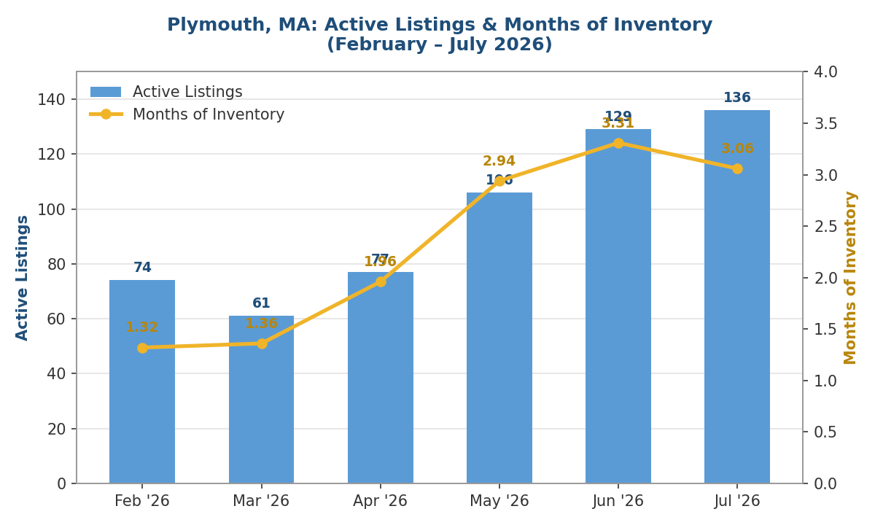
Plymouth’s housing market put on a different show this year than it did in 2025, and if you’ve been watching the “For Sale” signs pop up around town, you’re not imagining things — there are simply more of them. In February 2026, only 74 single-family homes were actively listed across Plymouth. By July, that number had nearly doubled to 136 active listings, one of the sharpest six-month inventory climbs we’ve tracked on the South Shore this year.
That inventory surge shows up clearly in the “months of supply” metric, which measures how long it would take to sell every home currently listed at the current sales pace. Plymouth’s months of inventory jumped from a razor-thin 1.06 months in January to 3.06 months by July — nearly tripling. For context, a balanced market (one that favors neither buyers nor sellers) typically sits between 4 and 6 months, so Plymouth is still leaning toward sellers, but the runway is clearly widening. Compare that to Massachusetts as a whole, where statewide months of supply sat at 1.94 in July — meaning Plymouth’s inventory is now looser than the state average, a notable shift for a town that’s historically run tighter than Massachusetts overall.
Homes are also sitting longer once they hit the market. Active listings in Plymouth averaged 90 days on market in July 2026, up from just 49 days in April 2025. Buyers have more to choose from, and they’re taking their time. That shows up in the sale-to-list price ratio too — Plymouth homes sold for 100.39% of asking in July 2026, a step down from the 102%+ bidding-war territory of summer 2025. Sellers are still getting close to full price, but the frantic, over-ask environment of last year has cooled.
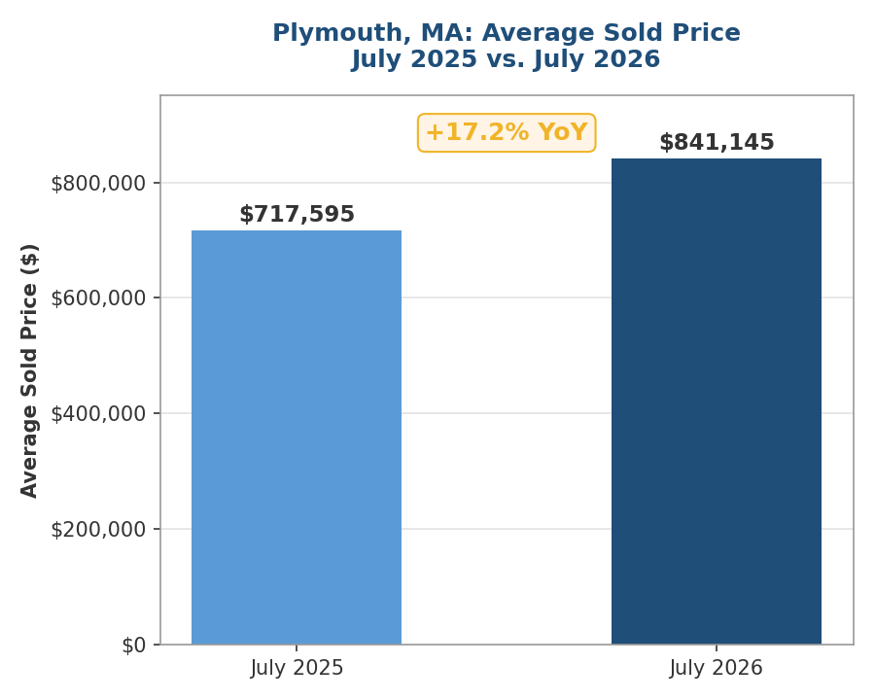
Here’s the twist, though: average sold prices haven’t followed suit. Plymouth’s average sale price hit $841,145 in July 2026, up nearly 17% from $717,595 in July 2025. Part of that is a genuine appreciation story — Plymouth continues to draw South Shore relocators, retirees, and remote workers priced out of the inner suburbs, pulled in by harbor views, a historic downtown, and the small-town character that earned Plymouth its “America’s Hometown” reputation. Part of it is also a smaller, pricier mix of homes closing each month — with fewer transactions than a year ago, a couple of higher-end waterfront or historic-district sales can swing the average noticeably.
Sales volume itself has softened from its January peak of 60 closed sales down into the high-30s and 40s through spring and summer, a pattern that lines up with the extra inventory and longer market times — buyers simply need more time to work through more choices. The share of Plymouth’s housing stock sold in the trailing 12 months climbed from 3.81% in March to 7.48% by July, showing the market has picked up real momentum even as pricing power moderates.
Sell Your Massachusetts House Fast!
We buy houses in Massachusetts in ANY CONDITION! Get a CASH offer with no commissions, agents, or hidden fees. Just enter your property address, phone, and email below, and you could receive your cash offer within 24 hours!
What does this mean if you actually need to sell a house in Plymouth this year? More competition on the market means more marketing, more showings, and more negotiation — and potentially those extra 30 to 40 days of carrying costs while buyers weigh a growing list of options. If you’ve inherited a property, you’re relocating on a timeline, or you’d rather not become one of the 136 listings competing for attention, Bluefin Property Buyers buys Plymouth homes directly for cash, as-is, with no repairs, no staging, and no waiting on a buyer’s financing to come through.
Is Plymouth, MA in a buyer’s market or a seller’s market right now?
As of July 2026, Plymouth is still leaning toward sellers, but the gap is closing fast. Months of available inventory nearly tripled from 1.06 in January 2026 to 3.06 in July 2026. Anything under 4–6 months of supply is generally still considered favorable for sellers, but Plymouth now has more breathing room for buyers than it has in over a year.
How long do homes typically stay on the market in Plymouth?
Active Plymouth listings averaged 90 days on market in July 2026, up sharply from 49 days back in April 2025. Homes that do sell are taking around 60 days on average from listing to closing.
What is the average home sale price in Plymouth, MA in 2026?
Plymouth’s average sold price was $841,145 in July 2026, up about 17% from $717,595 in July 2025, even as the overall pace of sales has slowed.
Are home prices in Plymouth still going up?
Year-over-year, yes — but the sale-to-list ratio has cooled from over 102% in summer 2025 to just over 100% in mid-2026, meaning homes are generally selling closer to asking price rather than sparking bidding wars.
What’s the fastest way to sell a house in Plymouth without waiting months for a buyer?
With inventory and market times both rising, a traditional listing in Plymouth increasingly means more competition and a longer wait. Selling directly to a local cash home buyer like Bluefin Property Buyers skips the showings, repairs, and financing delays entirely.
Selling your house doesn’t have to mean months on the market. Bluefin Property Buyers pays cash, buys as-is, and closes on your schedule — no repairs, no showings, no waiting. See how Bluefin Property Buyers can help you sell your Plymouth house fast Take the easy way out.